
I bet these 3-d Christmas trees would be fun to make with recycled Christmas cards. Pop on over to the blog Hattifant for the free printable and tutorial on how to make 3-d paper Christmas trees. They look great with a faux tea light popped inside.
Creative DIY Projects That Turn Trash Into Treasure
I bet these 3-d Christmas trees would be fun to make with recycled Christmas cards. Pop on over to the blog Hattifant for the free printable and tutorial on how to make 3-d paper Christmas trees. They look great with a faux tea light popped inside.
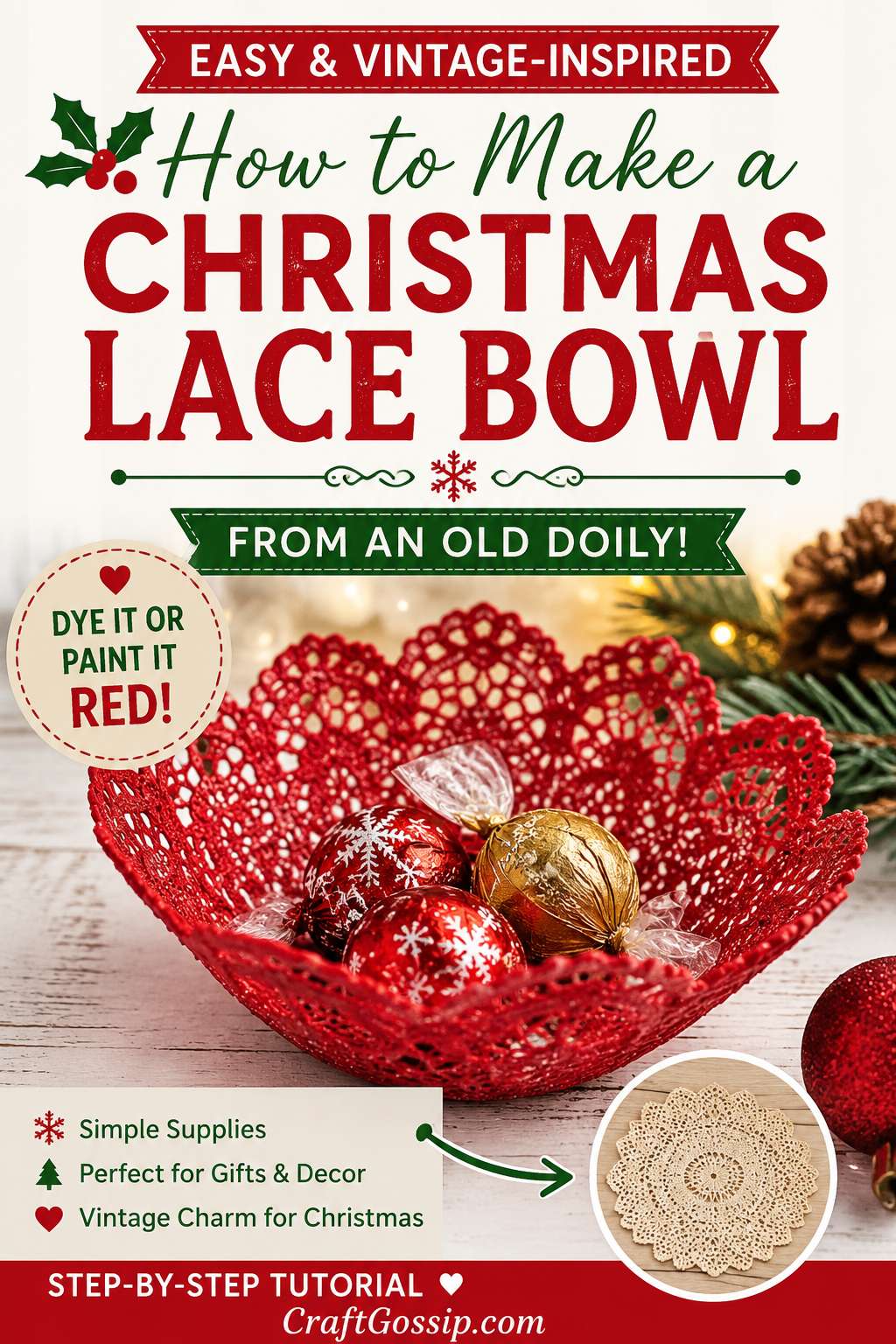
There is something so charming about a lace doily at Christmas, especially when it has that vintage handmade feeling that makes you think of biscuit tins, old linen cupboards, and someone’s grandmother who absolutely knew how to starch things properly.
This Christmas lace bowl is a pretty little upcycled craft made from an old lace doily, fabric stiffener or glue, and a bowl used as a mould. Once it dries, you end up with a delicate decorative bowl that can be used for wrapped sweets, baubles, jewellery, table favours, or festive little gift displays.
For this Christmas version, we are giving the lace a lovely red finish. You can either dye the lace using fabric dye for a deeper, more even colour, or paint it with watered-down red acrylic paint for a softer handmade look. Both methods work, and both have their own charm. The dye gives a more traditional fabric finish, while watered-down paint gives you a little more control if you want that slightly rustic, vintage Christmas feel.
This is a great project for using old doilies, thrifted lace, or crochet pieces that are too pretty to throw away but maybe not quite table-ready anymore. You know the ones — a tiny stain here, a pulled thread there, and suddenly they live in the “I’ll do something with this one day” pile. Well, today is that day.
If you enjoy vintage-style handmade decorations, you might also like this lace-inspired idea for DIY stamped air dry clay bowls, or have a browse through the CraftBits home crafts section for more easy handmade décor ideas.
These lace bowls are decorative rather than heavy-duty, but they are surprisingly useful during the festive season.
Use them for:
They also look beautiful on a mantel, sideboard, Christmas lunch table, bedside table, or craft room shelf. Just remember that these bowls are not washable and should not be used for wet food or anything heavy.
You will need:
If you are planning to make several of these for Christmas gifts or craft stalls, it is worth having a large bottle of craft glue or fabric stiffener on hand. A good foam brush, disposable gloves, and a self-healing craft mat or covered table will make the whole thing much less messy. You can usually find basic supplies like PVA glue, acrylic paint, fabric dye, foam brushes, and plastic wrap on Amazon. For vintage doilies and lace bundles, Etsy is always a lovely place to look, especially if you want mismatched old-fashioned pieces.
There are two easy ways to make your lace bowl red.
Fabric dye is best if you want a richer, more even red and your lace is made from cotton or another natural fibre. Vintage crochet doilies often dye beautifully, especially if they are cotton.
Fabric dye may not work as well on synthetic lace, so check the fibre if you can. If you are using a thrifted lace piece and have no idea what it is made from, do a small test first.
Watered-down acrylic paint works well if you want a softer red finish or if your lace is synthetic and may not take dye properly. It is also handy if you only need to make one bowl and do not want to set up a full dye bath.
This method gives the lace a more painted, handmade finish. It can be a little rustic, which I personally think suits Christmas crafts beautifully.
Choose a clean lace doily with a pretty pattern. Round doilies are the easiest to shape into bowls, but oval or square pieces can work too.
Look for lace with strong details such as flowers, scalloped edges, stars, leaves, or repeating patterns. Once the lace is stiffened, those details become the feature.
Avoid lace that is too fragile, torn, or full of loose threads. A little wear is charming. Falling apart in your hands is less charming.
If your lace has stains, do not worry too much if you are dyeing or painting it red. The colour will hide many small marks.
If your lace is thrifted or has been stored for a long time, give it a gentle wash first.
Use warm water and mild soap, then rinse well and let it dry completely. This helps remove dust, oils, or old starch that could stop the dye or paint from soaking in properly.
Do not use fabric softener, as it can interfere with the stiffening process later.
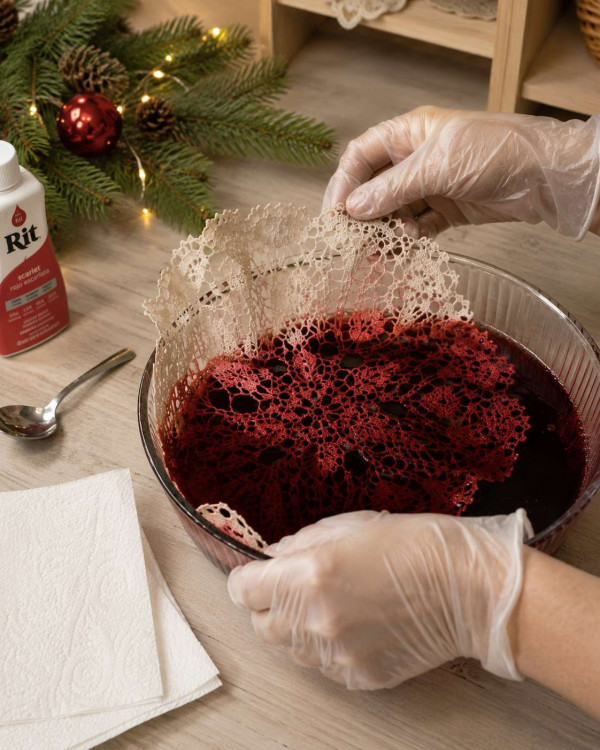
Now it is time to turn the lace into something festive.
Follow the instructions on your fabric dye packet, as different brands vary slightly.
As a general guide:
For a deep Christmas red, you may need to leave the lace in the dye bath a little longer. Keep in mind that lace often looks darker when wet and slightly lighter once dry.
If you are using acrylic paint, mix:
1 part red acrylic paint to 1 part warm water
Stir until smooth. The mixture should be thin enough to soak into the lace but not so watery that the colour disappears.
Place the lace on baking paper or plastic wrap. Use a foam brush to dab the paint mixture into the lace, making sure both sides are covered. You can also dip the lace directly into the mixture and gently squeeze out the excess.
If you want a darker red, let the first coat dry and then add a second coat.
For a rustic vintage look, do not worry if the colour is slightly uneven. It gives the bowl a lovely handmade finish.
Let the lace dry before moving on to the stiffening step.
Choose a bowl, jar, or rounded container that matches the shape you want.
Turn the bowl upside down and cover it tightly with plastic wrap. Smooth out as many wrinkles as possible, because big folds in the plastic can leave marks in the lace.
Place the covered bowl on baking paper or newspaper. This is a gluey project, and it is much nicer to throw away a messy sheet of paper than scrape dried glue off the table later.
You can use ready-made fabric stiffener or make your own with white craft glue.
For homemade stiffener, mix:
2 parts white PVA glue to 1 part warm water
For example:
Stir until smooth.
If the mixture feels too thick to soak through the lace, add a tiny splash of warm water. If it feels very runny, add a little more glue. You want the lace fully coated, but not dripping in puddles.
Place the red lace into the stiffener mixture and gently press it down until it is fully saturated.
Use your fingers or a foam brush to work the stiffener through the pattern. Make sure the edges and centre are coated well, because those areas help the bowl hold its shape.
Lift the lace and let the excess drip back into the container. Do not wring it out, as that can stretch or distort the lace.
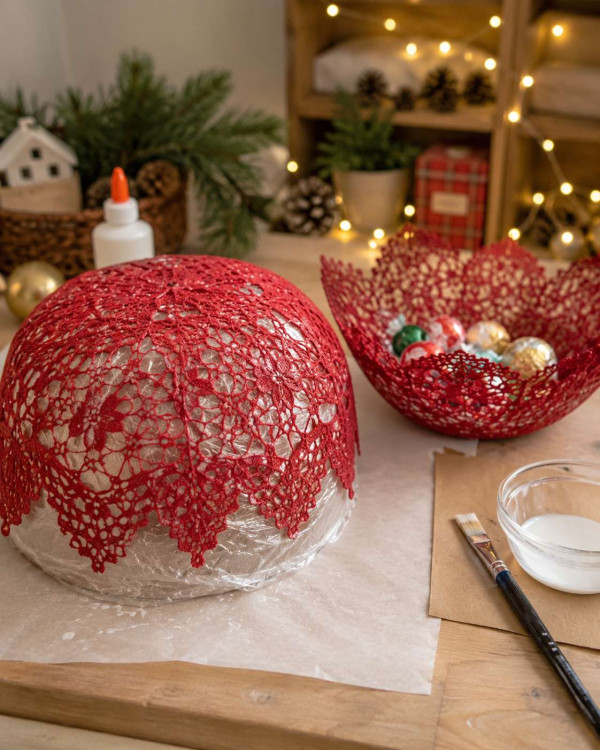
Carefully drape the wet lace over your plastic-wrapped bowl form.
Centre the lace so the pattern sits nicely. Smooth it gently with your fingers and arrange the edges so they fall evenly around the bowl.
You can create:
Once you are happy with the shape, dab a little extra stiffener onto any areas that look dry.
Leave the lace bowl to dry for at least 24 hours.
If your lace is thick, heavily painted, or the weather is humid, it may need 48 hours or longer. Do not rush this step. A lace bowl that is removed too early can sag, flop, or lose its shape.
Place it somewhere safe where it will not be bumped. If you have pets, put it somewhere they cannot “help.” Every crafter knows that cats and drying projects have a special and dangerous relationship.
Once the lace is completely dry and firm, gently lift it off the bowl form.
Peel away the plastic wrap carefully. If any areas still feel soft, place the lace bowl upright and let it dry longer.
If the base is a little uneven, lightly mist just the bottom with water and press it gently onto a flat surface. Let it dry again before using.
Your red lace bowl can be left as it is, or you can dress it up a little.
Try adding:
A touch of gold paint on the rim looks especially pretty for Christmas. Use a small brush and go lightly so you still see the lace detail.
These red lace bowls look beautiful in all sorts of festive settings.
Try placing one:
For a vintage Christmas table, mix red lace bowls with greenery, old brass candlesticks, white plates, and linen napkins. It looks fancy without needing to actually be fancy, which is my favourite sort of decorating.
You can use spray paint, but it gives a different finish. Spray paint tends to sit more on top of the lace rather than soaking into it. It can also clog up the delicate openings if sprayed too heavily.
If you use spray paint, apply very light coats and let each coat dry before adding another. For this project, I prefer fabric dye or watered-down acrylic paint because the lace still looks soft and detailed.
Yes, crochet doilies work beautifully for this craft. In fact, they often hold their shape very well because the cotton thread is thicker than fine lace fabric.
A crochet doily may need extra stiffener and a longer drying time, especially if it has raised stitches or a dense centre.
Brush on another coat of fabric stiffener or glue mixture and let it dry again. Make sure the lace is fully dry before judging the final stiffness.
If you used paint, add a second thin coat. If you used dye, the lace may contain synthetic fibres that did not absorb the dye evenly. A watered-down paint wash can help even it out.
Peel slowly and gently. Next time, make sure the lace is not sitting in a thick puddle of glue at the base.
This usually means there was too much glue sitting on the surface. You can often disguise it with a little red paint, gold dry brushing, or glitter.
Handmade lace bowls often have a soft organic shape. If you want to adjust it, lightly mist the area with water, reshape gently, and let it dry again.
These make sweet handmade gifts, especially if you fill them with something small.
Try filling them with:
Wrap the filled bowl in cellophane and tie it with ribbon for a simple handmade gift. It is the sort of present that looks thoughtful without requiring three days of emotional recovery afterward.
This Christmas lace bowl is a lovely way to give old doilies and lace scraps a festive second life. Whether you dye the lace a rich Christmas red or paint it with watered-down acrylic for a softer rustic finish, the result is delicate, handmade, and full of vintage charm.
It is simple enough for beginners, affordable enough to make in batches, and pretty enough to use for gifts, table décor, or craft stall stock. And best of all, it lets you turn something forgotten into something festive — which is exactly the sort of Christmas crafting I love.